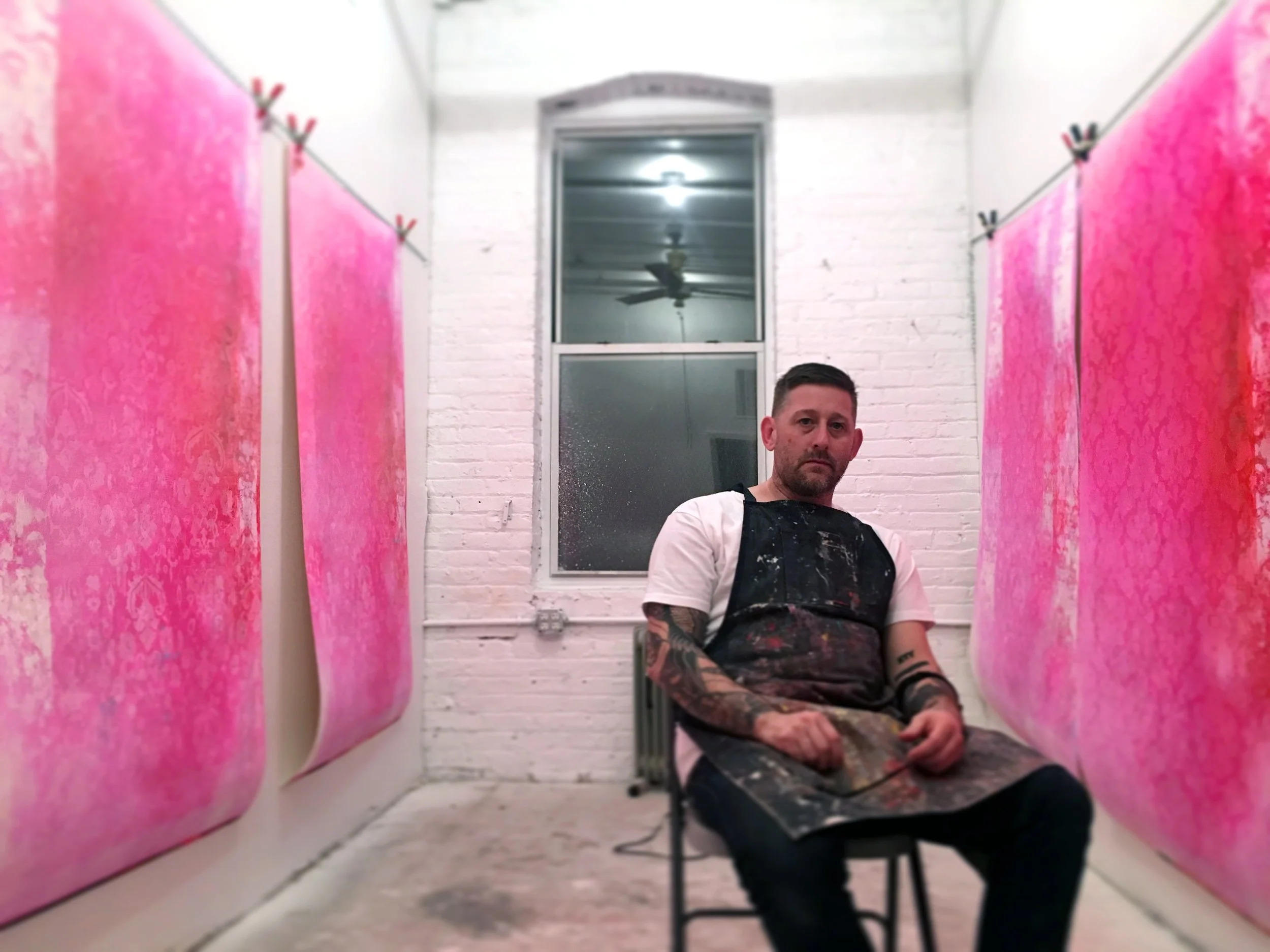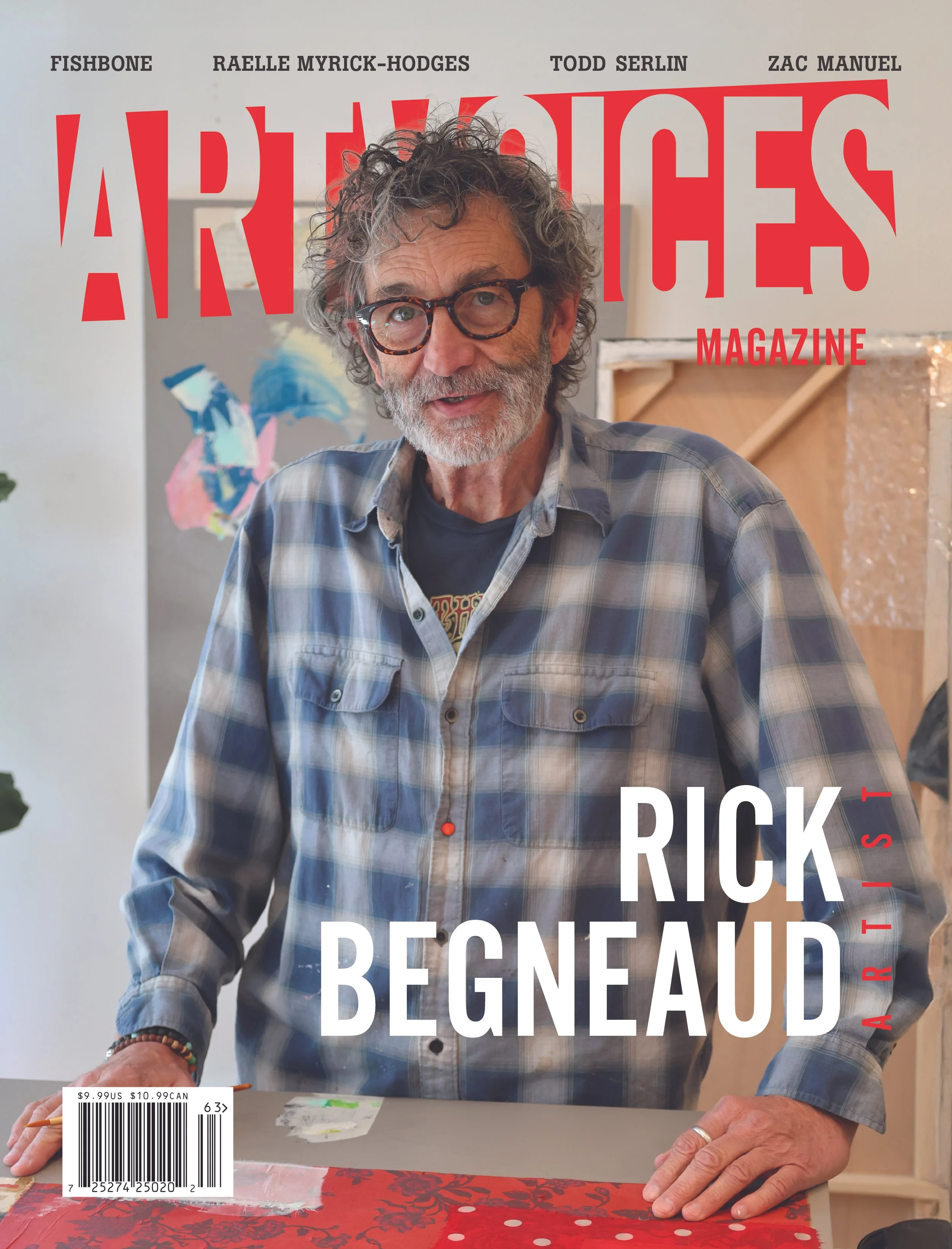
MID-CAREER: TODD SERLIN MATERIALITY, MEMORY, AND THE ETHICS OF REPRESENTATION
“…you don’t need an art degree to be moved by a figure that looks like it might step off the canvas. But the deeper you look, the more the work asks of you. That tension between immediate recognition and open interpretation is where I want to live.”
Todd Serlin’s artistic practice occupies a compelling space where material experimentation intersects with cultural inquiry. Rather than offering fixed narratives, his work invites viewers into a sustained examination of memory, perception, and the social conditions that shape contemporary experience. Through a visual language that balances formal precision with conceptual depth, Serlin transforms familiar imagery and material processes into meditations on presence, absence, and the fragile relationship between personal history and collective consciousness. His paintings and mixed-media works resist passive viewing, asking audiences to confront not only what is represented but also the systems of meaning that inform how images are produced, consumed, and remembered.
Situated within the broader discourse of contemporary American art, Serlin’s practice reflects an enduring commitment to art as a critical form of inquiry. His work engages questions of representation, history, and human vulnerability while maintaining a rigorous attention to
the physical properties of the medium itself. Rather than separating aesthetics from ethics, Serlin demonstrates how the formal language of painting can become a site for examining the complexities of our cultural moment. In doing so, his work contributes to an ongoing dialogue about the role of contemporary art as both witness and catalyst, reaffirming the capacity of visual practice to challenge perception, provoke reflection, and deepen public understanding.
Julien Smith: Your work has been associated with artists as diverse as Jean Dubuffet, Weegee, Keith Haring, and Robert Longo. How have these artists shaped your thinking, and where do you see your practice departing from theirs?
Todd Serlin: My early development was rooted in graffiti, wildstyle linear work, dense, intricate, bursting with energy but not yet sure of what it wanted to say. Then, in my late teens, Keith Haring stopped me cold.
What he did was take line to its most essential, most democratic form - urgent, bold, alive with social meaning. His continuous line wasn’t just a style, it was a declaration. For me, coming out of that complicated, over-worked graffiti influence, Haring gave me permission to open things up, to trust the power of simplicity, to let the line breathe.
If Haring taught me the line, Jean Dubuffet gave me permission to weaponize it. The way he built figures from raw, almost crude primitive outlines - assembling an entire psychological architecture from something that appeared unrefined, was extraordinary. In a way, it shattered my preconceived notions of form. Dubuffet proved that refusing convention wasn’t a limitation - it was a commitment to truth. His influence gave me the confidence to stay in the abstract, figurative lane. In many ways, it was my “North Star” as I was learning to navigate style, experiment, and produce my early works.
Robert Longo’s Men in the Cities touched a completely different nerve. His hyper-stylized, arresting take on the human form, caught between violent movement and ecstatic surrender, was so real for me. While my early attempts at capturing that gestural tonality didn’t satisfy me, Longo’s tension remains a vital presence, inspiring my Body Count series. He showed me how a single figure could freeze an entire cultural moment through sheer velocity. And
as much of Body Count refrains from that sense of speed and explosive movement, Longo’s influence certainly affects my choices and process.
Weegee is a more recent, anchoring influence - specifically for the Body Count series. I found his work through research as the ideas were being conceptualized. Weegee’s mid-century world of raw, high-contrast, black- and-white photojournalism pulled me in immediately. And his personal story, how we became popularized as the original voice of a genre really hit home for me, especially being from a totally different generation. He captured the fucking essence and practical reasoning behind the singular chalk outline. There was something in his honesty, and the dark beauty of the human condition that he captured that activated everything. And all my prior influences collapsed together and pointed toward what this series needed to be.
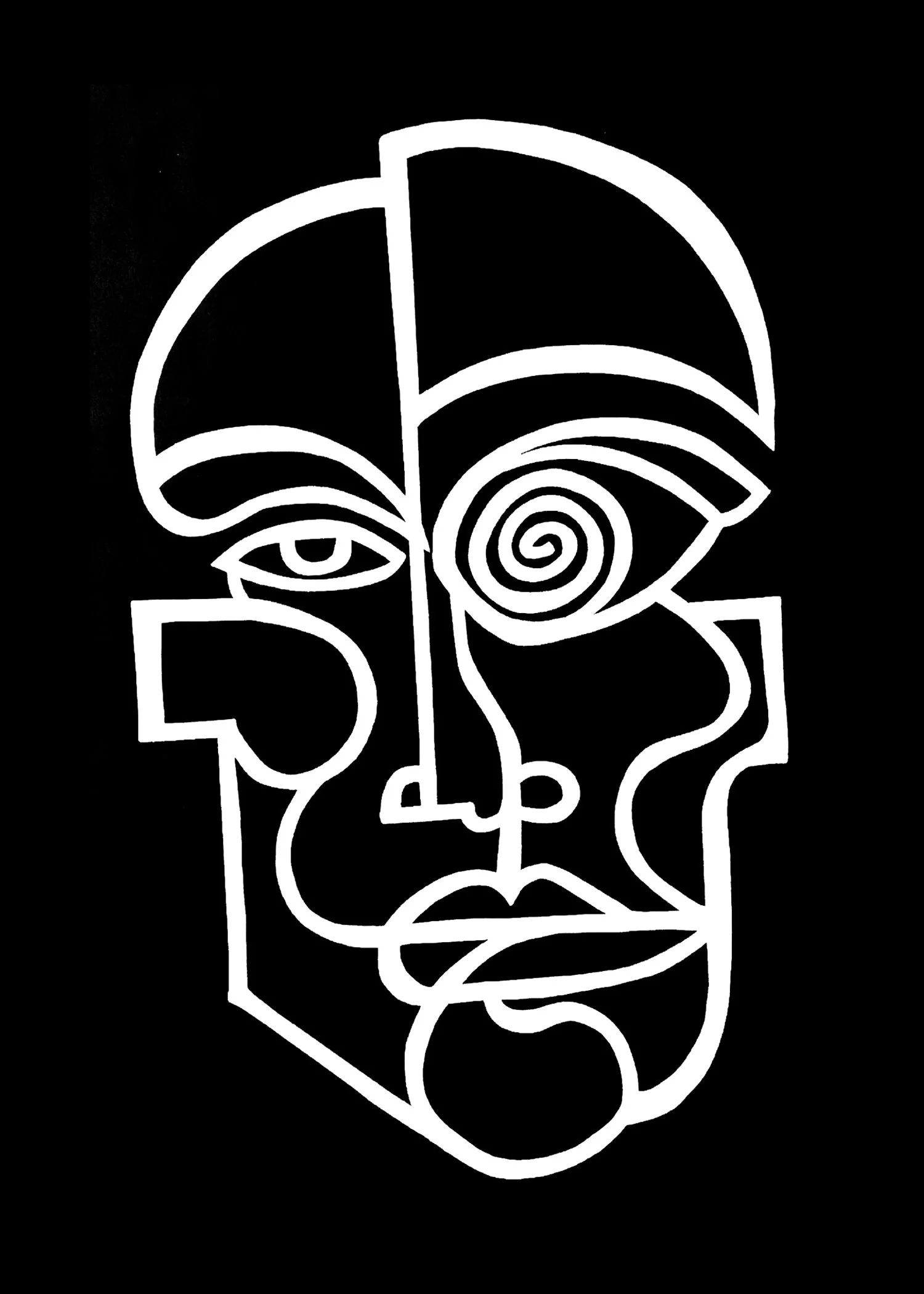
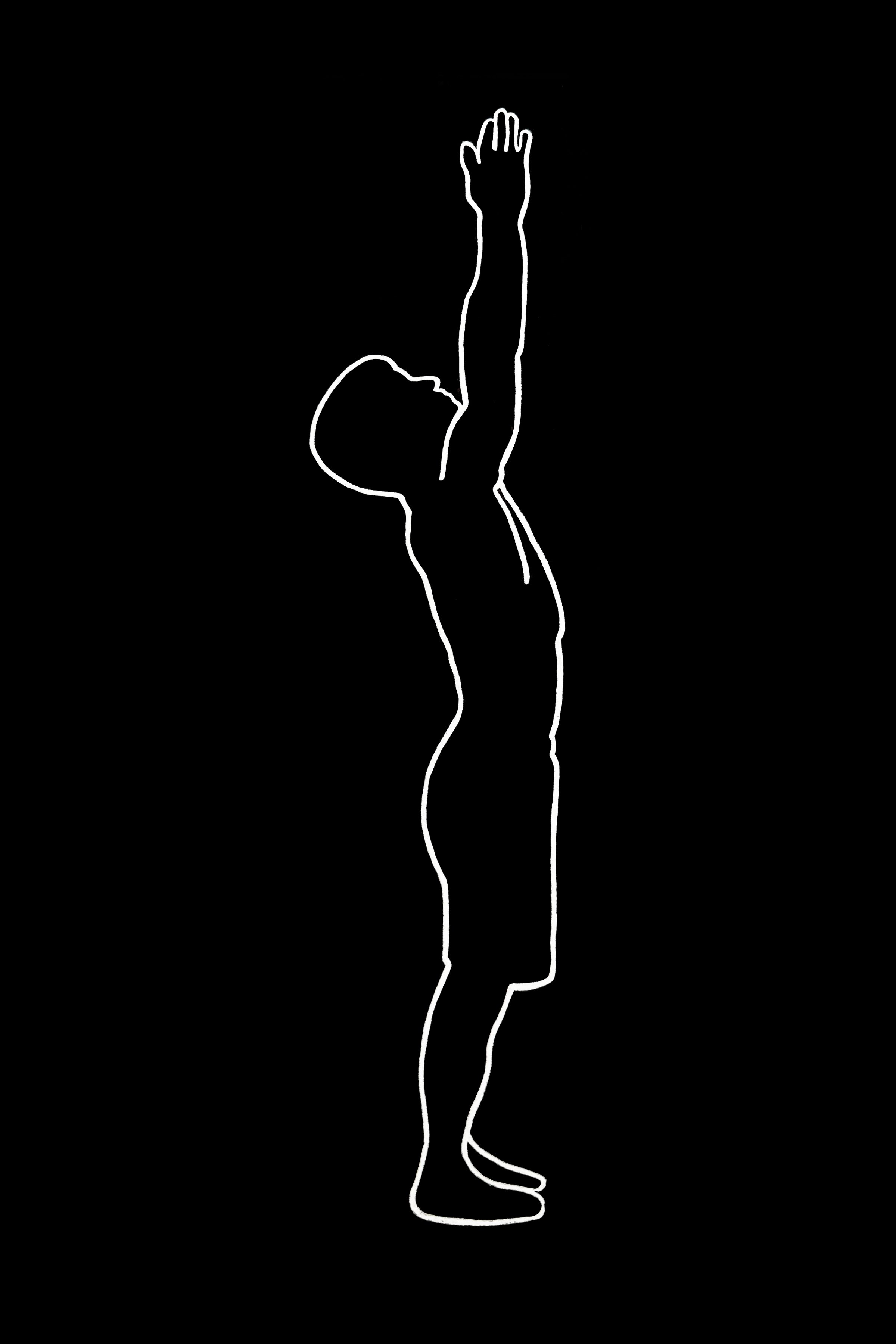
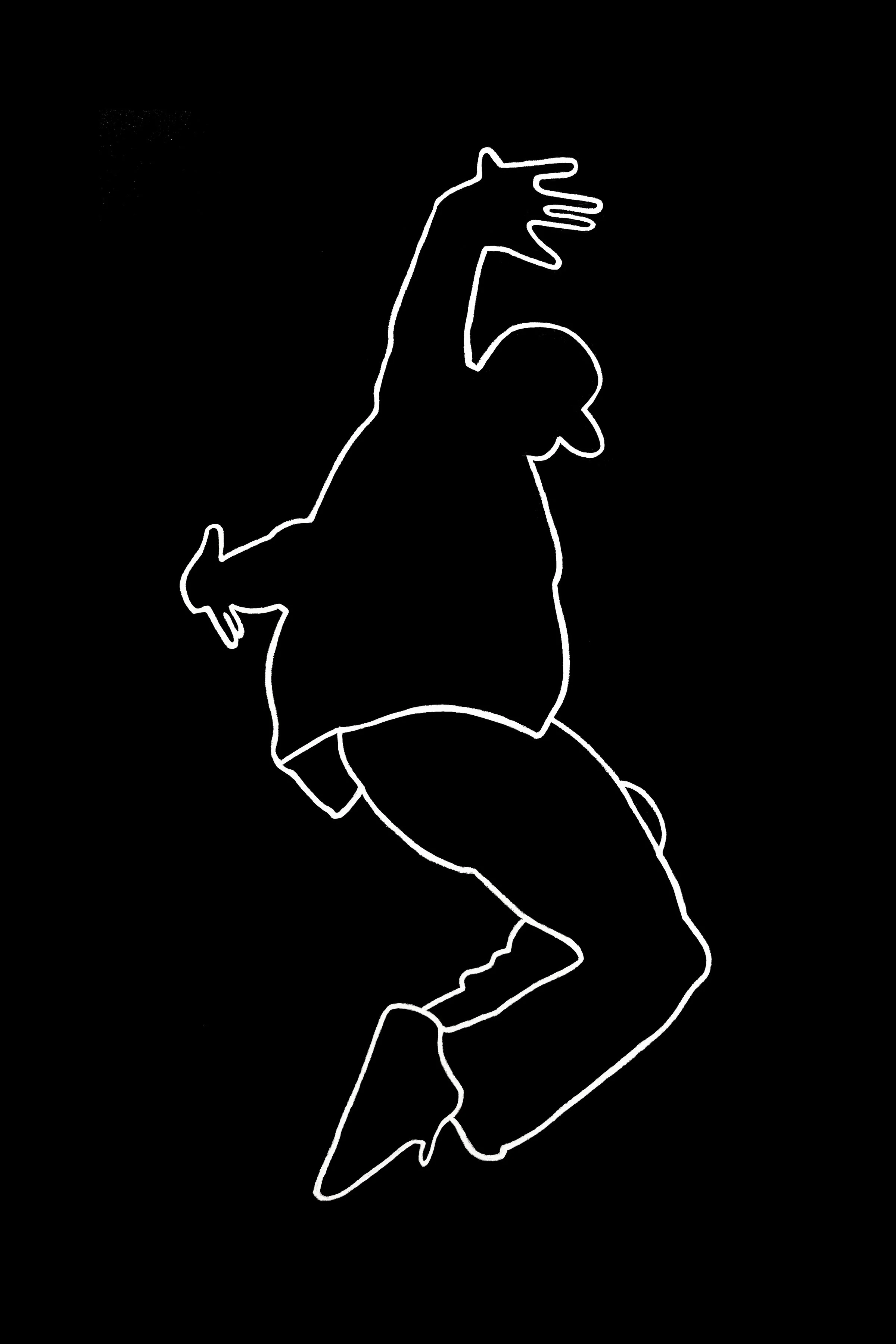
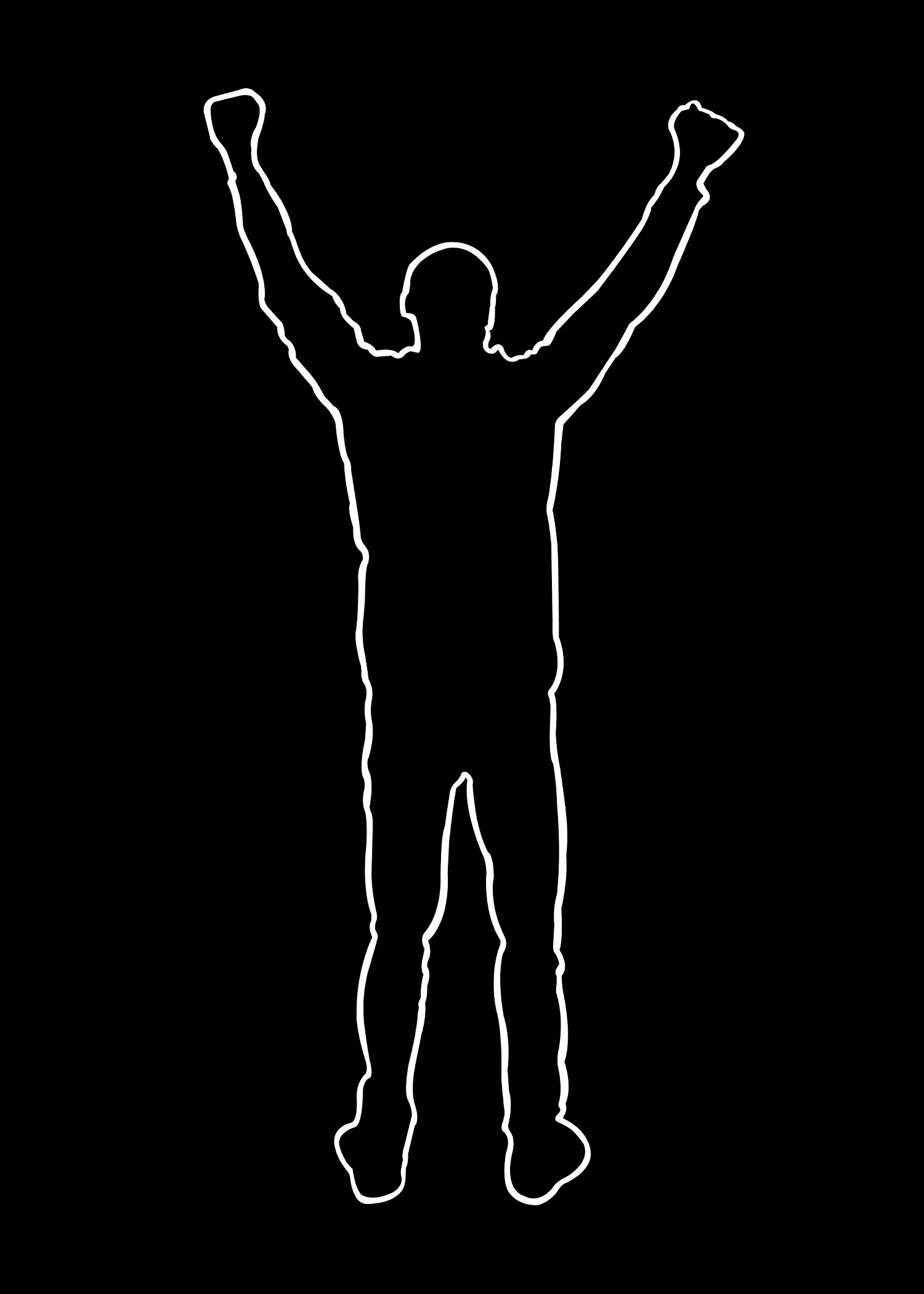
These four artists helped shape the language I speak. But where I depart is in the intention behind the line itself. My work is not documentation, reportage, or expressionism for its own sake. The singular outline in Body Count is my deliberately stripped-down activation; my attempt to deliver presence without identity, form without information. I’m asking the viewer to complete the work’s definition, to bring their own history into that empty interior. That conversation between the painted edge and the viewer’s imagination - that’s mine.
JS: Looking back over your career, what first compelled you to pursue painting and drawing as your primary forms of expression?
TS: It started the way most things do without knowing it was starting. Drawing monsters as a kid, coming to school every day with new work to compare and compete with friends. Pure play. Pure energy. That impulse ran through other channels for years - music, film, a full chapter in Hollywood writing screenplays and producing. Visual storytelling consumed me, but the mechanics of the industry had a way of encouraging and strangling creativity at the same time. For a minute I got some “heat,” but ultimately scripts lived on desks. Work sat in piles. Nothing was on walls. Something was missing, and I needed clarity.
The pivot came when I was diagnosed with Type 1 Diabetes. That was my darkest period - life was going to be very different, permanently. And painting became the sacred place I could go when nothing else held. It wasn’t therapy in any clinical sense it was more primal than that. The brush, the paint, the canvas gave me a controlled space to process an uncontrollable reality. In that isolation, painting became my refuge and my salvation. And what came out was raw, unrelenting creativity with no guardrails. I stopped asking for permission to tell stories. I started painting them. In hindsight, I’d say that expression was and continues to be an act of survival for me.
JS: Was there a defining moment when you recognized that art would become a lifelong commitment?
TS: During that dark period after my diagnosis, I was painting larger scale work, leaning into different territories - abstract, figurative, primitive. The monsters were still there, representing something true about the human condition. I was painting out of sheer necessity, and then almost immediately, collectors began to notice. That moment of clarity hit me in a powerful way. It was time to stand up and bring it hard. My work wasn’t going to sit in a pile on someone’s desk anymore. It was going to live on walls. It was going to occupy physical space in the world and alter the energy of the rooms it lived in. That shift from passive development to active, physical presence took on a profound, almost spiritual meaning for me. It became a personal call to action I haven’t stopped answering since. Art was no longer something I did. It became a fundamental part of what I was, who I am; where I am going.
“Flaws are where truth lives.”
JS: Dubuffet challenged conventional ideas of beauty and celebrated raw, intuitive expression. What aspects of his philosophy continue to resonate with you?
TS: Dubuffet’s philosophy may somehow have been hard coded into my DNA., even if it took a while to fully surface. His refusal to subscribe to what institutions tell us beauty is supposed to look like has always resonated with me. Much of my early work was built around monsters, figures that were deliberately flawed and scarred - because I believed then as I do now that flaws are where truth lives. Dubuffet understood that culture often suffocates instinct. His celebration of raw, intuitive expression, what he called Art Brut, stood as a serious philosophical backbone. And it gave me permission to stay in the primitive lane without apology. Referring to his work and his journey kept me on track when I questioned myself.
In my current work, while the aesthetic has evolved, that underlying tension is still very much intact. I celebrate the human form, but I leave the silhouettes intentionally open. The line has weight and intention, but it retains the vulnerability of a hand-drawn mark. It’s not perfect. It doesn’t want to be, and it took me a while to understand and respect that. Dubuffet’s work, at its core, was about rejecting the hierarchies that told people what to appreciate and why. My ork operates from a similar impulse I want whoever stands in front of it to feel that the space inside that outline belongs to them. Not to me. Then the expansion of dialogue can come alive - the viewer co-authors the meaning. To me this is a realization of Dubuffet’s philosophy.
JS: Your work often possesses an immediacy that appears instinctive rather than calculated. How important is spontaneity within your studio practice?
TS: Before Body Count, my studio practice was 100% pure instinct. I would show up and let energy dictate everything. It was all an experiment spontaneous combustion was how
I developed my voice, my technique, my confidence. And in so many ways, my technique was aggressive, improvisational experimentation, where the act of painting itself dictated the outcome.
Body Count changed the terms completely. The controlled chaos I clung to was replaced with intention, distillation, and reduction. Now there is real thought before the first mark, because the work lives and dies bythe line. Selecting a figure, thinking through the gesture, understanding how each new piece expands the dialogue of the series - all of that requires a precision my earlier practice never demanded.
The actual act of making the mark is still cathartic. What looks simple to the viewer involves steady, deliberate repetition, and each canvas has its own challenges and small victories. I still occasionally return to the old way, showing up with nothing and letting go - because that impulse never fully leaves you. But the central focus of my practice now is building something that accumulates meaning, work that tells a larger story than any single piece can carry by itself. The singular power of the definitive line is everything to me right now. I just love it.
“Authenticity is the long game.”
JS: Weegee documented New York’s streets with remarkable honesty. How has urban life informed your own visual language?
TS: Being from New York, and spending most of my adult life in San Francisco and Los Angeles, urban life is gravity - always the figurative ground I stand on. The cracks in the pavement, the architecture, the energy in the streets - that immediate, physical, sometimes harsh reality was the original grammar of my visual language. That shit you can’t unlearn, no matter how much refinement becomes part of the formula.
Weegee crystallized something for me when I was developing Body Count. His photographs don’t romanticize or explain, they present. A body on a sidewalk. A crowd gathered. The city as witness. That high-contrast, unflinching honesty, the presence and absence sitting side by side, that’s something my work is in direct conversation with. The chalk outline has its own urban inheritance: the crime scene, the street, the boundary drawn around what was once alive. That’s the real shit.
As I traveled globally, that foundational urban literacy allowed me to recognize similar patterns in indigenous cultures, in how communities visually express their shared realities. I try to be a sponge every time I visit a foreign place, visually and spiritually to inform my experience and artistic point of view. But the core remains the pavement. Weegee showed me how brutal honesty, handled with a certain restraint, can become art that transcends its moment. That’s the lesson I keep returning to.
JS: Do you see yourself documenting contemporary society, or interpreting it?
TS: Both - and I don’t think you can fully separate them. Body Count is documentary in the sense that it draws directly from the current moment, from what I see, what I read, what I carry as a person moving through a fractured world. But it’s also deeply interpretive, because every figure is a distillation. I’m pulling from art history, from geopolitics, from religion, from the collective weight of cultural memory, and asking: what does this look like when you reduce it to a single line?
The Hero’s Journey has always been a central motivation for my figurative work. How it manifests in each new painting offers a unique extension of its meaning to me.
Sometimes, I’m pulling historical archetypes forward and colliding them with a contemporary reflection. By reducing these heavy concepts into stark, large-scale silhouettes, I’m documenting the weight of our historical moment while simultaneously creating an arena where the viewer is encouraged to confront our collective place in it.
What I’m really after is connection. I want someone standing in front of one of these works to feel the weight of our shared condition, and then decide for themselves what that weight means. That’s where documentation ends and interpretation begins. I set the stage. The audience completes the scene.
JS: What attracts you to subjects that reveal the psychological complexity of humanity?
TS: Because that’s where everything honest lives. Psychological complexity isn’t a category of subject matter, it’s the human condition itself. Every figure I paint carries a posture, a gesture, a specific relationship to the space around it. That relationship is never neutral. It suggests power or vulnerability, stillness or readiness, openness or isolation. I want Body Count to establish a radical connective tissue - to build a bridge that spans across disparate belief systems, geographies, races, and ideologies. To do that, the work has to be accessible - the simplicity of the form ensures it can be instantly processed. The human form is our most universal language, and the nuanced tension of the gesture brings a certain psychological echo.
What excites me most is when a figure I’ve conceived with a specific intention gets read in a completely different way by someone standing in front of it. That’s not a failure of communication, that’s the work functioning exactly as intended.
JS: Keith Haring believed art should be accessible to everyone. How important is accessibility within your own work?
TS: It’s actually funny that I just mentioned accessibility - it is the central pillar of my philosophy, and it means more than one thing to me. On one level, it’s literal: I want this work to exist in public spaces, on walls in neighborhoods, in the streets, wherever. That’s where my roots are the tradition of art meeting people where they are is something I take seriously. I use forms that people immediately recognize - the human figure, the gesture, the outline. The entry point is low and it’s instantaneous - you don’t need an art degree to be moved by a figure that looks like it might step off the canvas. But the deeper you look, the more the work asks of you. That tension between immediate recognition and open interpretation is where I want to live.
A more mature version of myself would say accessibility is giving anyone who stands before the canvas the agency to participate in the dialogue. And that’s my real motivation - reaching someone, engaging them, making them feel that this space is theirs to enter. On that note, I have to pay proper homage where it’s due. Haring took the line out of elite institutions, put it in the subways, and ultimately forced the institutional art world to accept its universal brilliance. And the fact that he leveraged that at a moment in history when his voice carried such urgent, devastating gravity - AIDS, apartheid, nuclear threat - that accessibility became the ultimate form of truth, relevance, and legacy.
JS; Haring successfully blurred distinctions between fine art and popular culture. How do you navigate those boundaries?
TS: I think what Haring actually did was make the fine art category argument irrelevant. His work, at first glance, was playful and joyous but it carried genuine social urgency and immense, devastating gravity. And it was everywhere quickly. The fine art world eventually caught up to what the streets already knew. That’s the model I find most honest. I don’t spend much time thinking about which side of the line I’m on. Imagination is transportation it doesn’t need a passport. The distinction between fine art and popular culture is an artificial hierarchy constructed by institutions, ot by creators. What matters to me is whether the work lands, whether it creates a genuine response, whether it opens a door someone didn’t know was there.
JS: Robert Longo’s work explores tension, power, and psychological drama. How do those ideas relate to your own practice?
TS: Longo’s figures exist in a state of arrested crisis - they’re falling, or they’ve just been hit, or they’re caught in some invisible force field between power and collapse. That psychological charge is present before you even know the context. The body carries the drama entirely on its own. That’s central to Body Count, but I suppose I arrive at it through a different, inverse logic. Longo fills the figure with gesture, muscle, and detail. I empty it. I reduce the figure to its outline and ask - can tension live in a boundary alone? Can drama exist in just that contour?
By confining my narrative to a singular bold line, the outline itself becomes an instrument of containment. I see the tension generated by what is withheld. That line colliding with the negative background space implies a great deal - but for me, the restraint required to execute that balance is where the power lives. The space inside the line becomes the site of all the psychological complexity Longo externalizes. Working with less - that’s where I think my practice takes what he pioneered and asks a different, and I believe equally compelling, question.
JS: Many of your compositions convey movement and emotional intensity. What role does the human figure play in communicating those ideas?
TS: The human figure is the most universally legible thing I can put on a canvas. People process it immediately, before they think or interpret - the body registers.
This is where the practice becomes deeply exhilarating. I get to take that immediate recognition and complicate it through gestures or archetypal reference. A figure with arms raised means a dozen different things depending on what the viewer brings to it. Surrender. Celebration. Prayer. Fear. Joy. The gesture is the invitation, and I want it to say: bring yourself to this and help define it.
At exhibitions, when someone tells me they’re seeing somethin I never consciously intended but I can immediately recognize exactly what they see... that’s the work alive. That connective tissue between my intention and their experience is what drives me. I have no interest in dictating an ideology. I want to inspire a fierce, open dialogue.
JS: Can you describe your creative process from the first mark to the completed work?
TS: My creative process has fundamentally changed, and in all honesty, it’s still finding its footing. Early on, I showed up and let energy dictate form. Now the work begins long before I pick up a brush in the conceptual phase, deciding on a figure or a set of figures, thinking through the gesture, understanding how this particular piece will speak to the others in the series. Because each work ultimately lives as part of a larger conversation, every individual decision carries real weight.
My dad used to say: “If it was easy, everyone would be doing it.” That statement has kept me going more times than I can count.
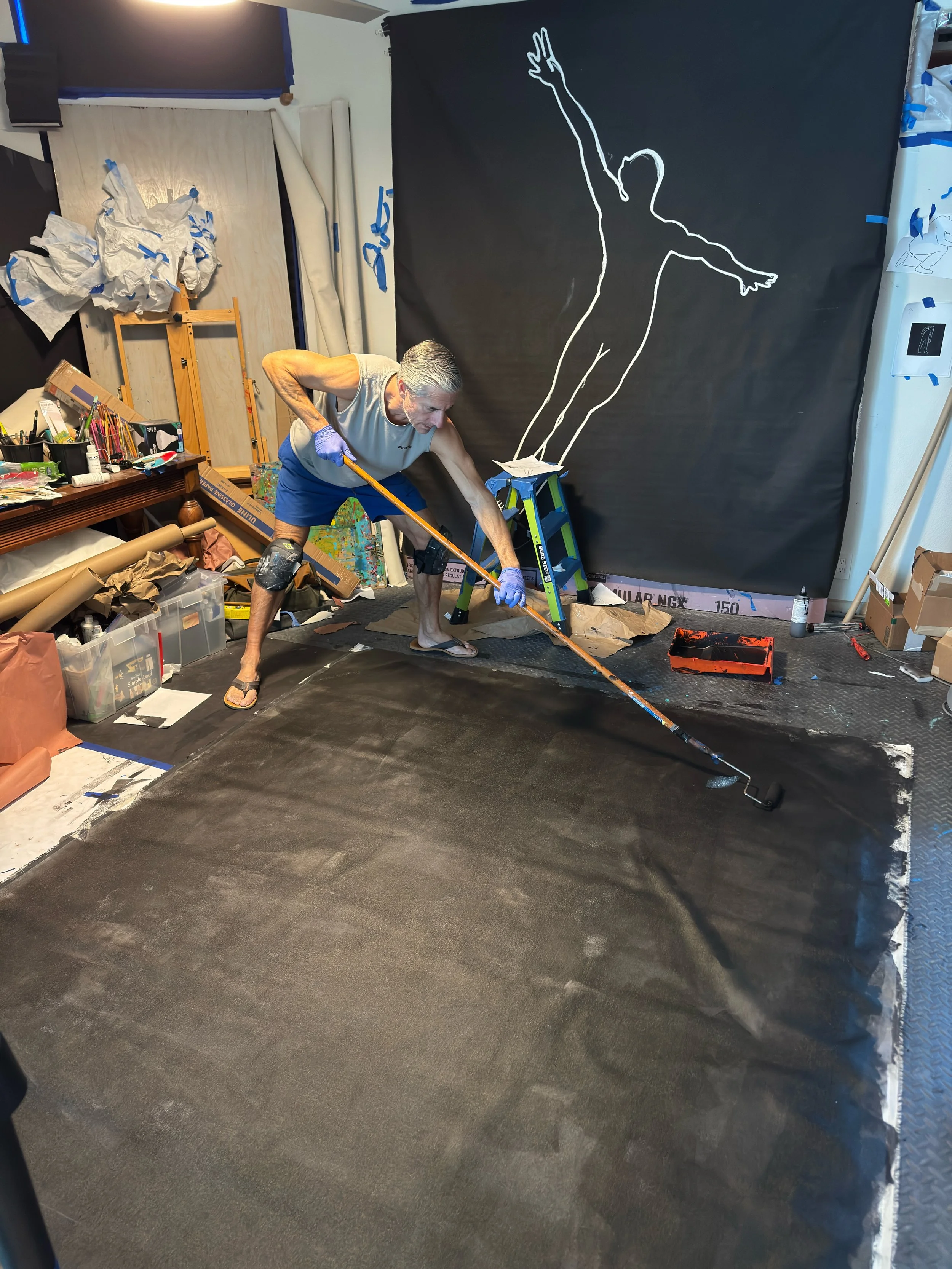
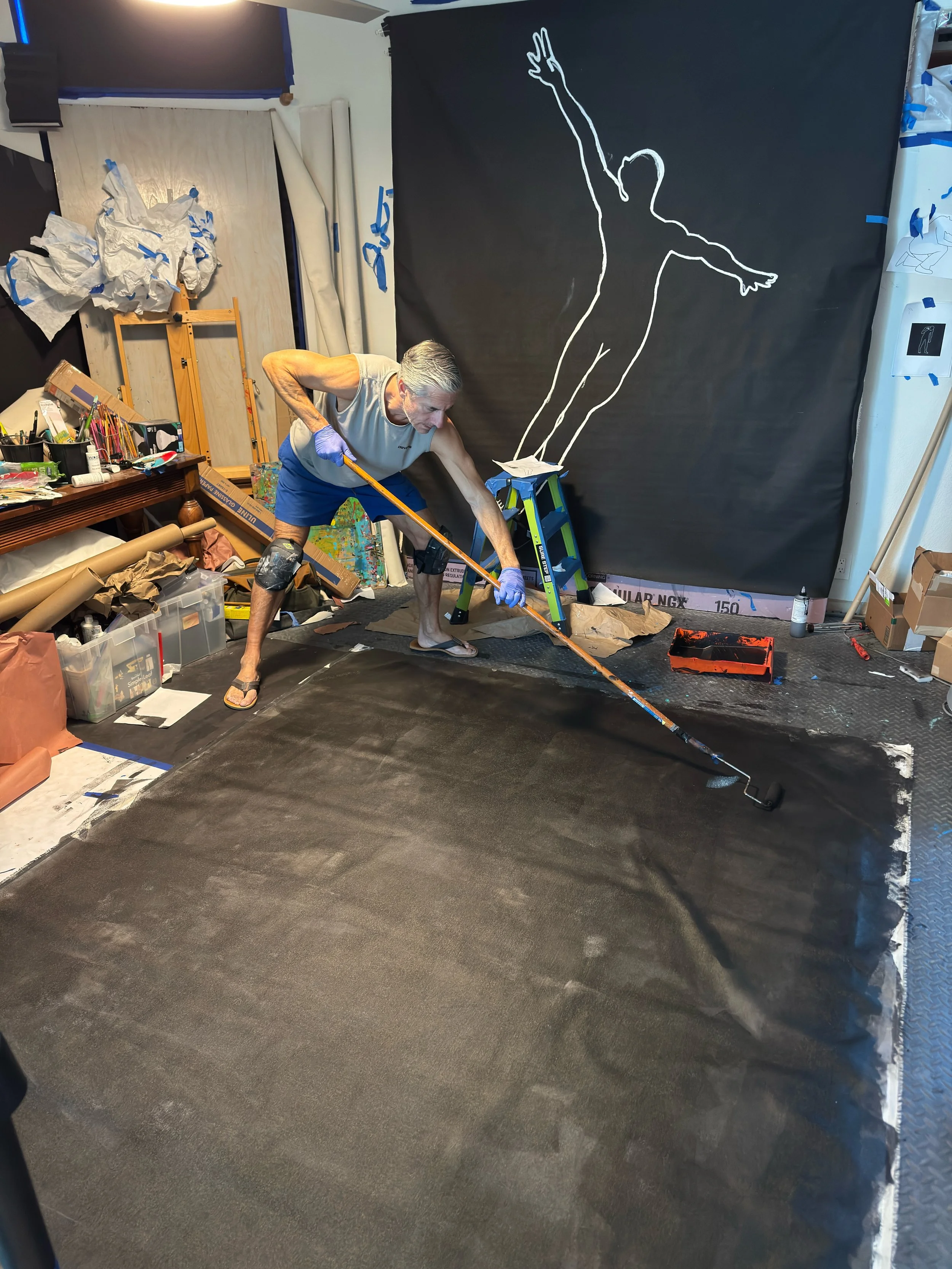
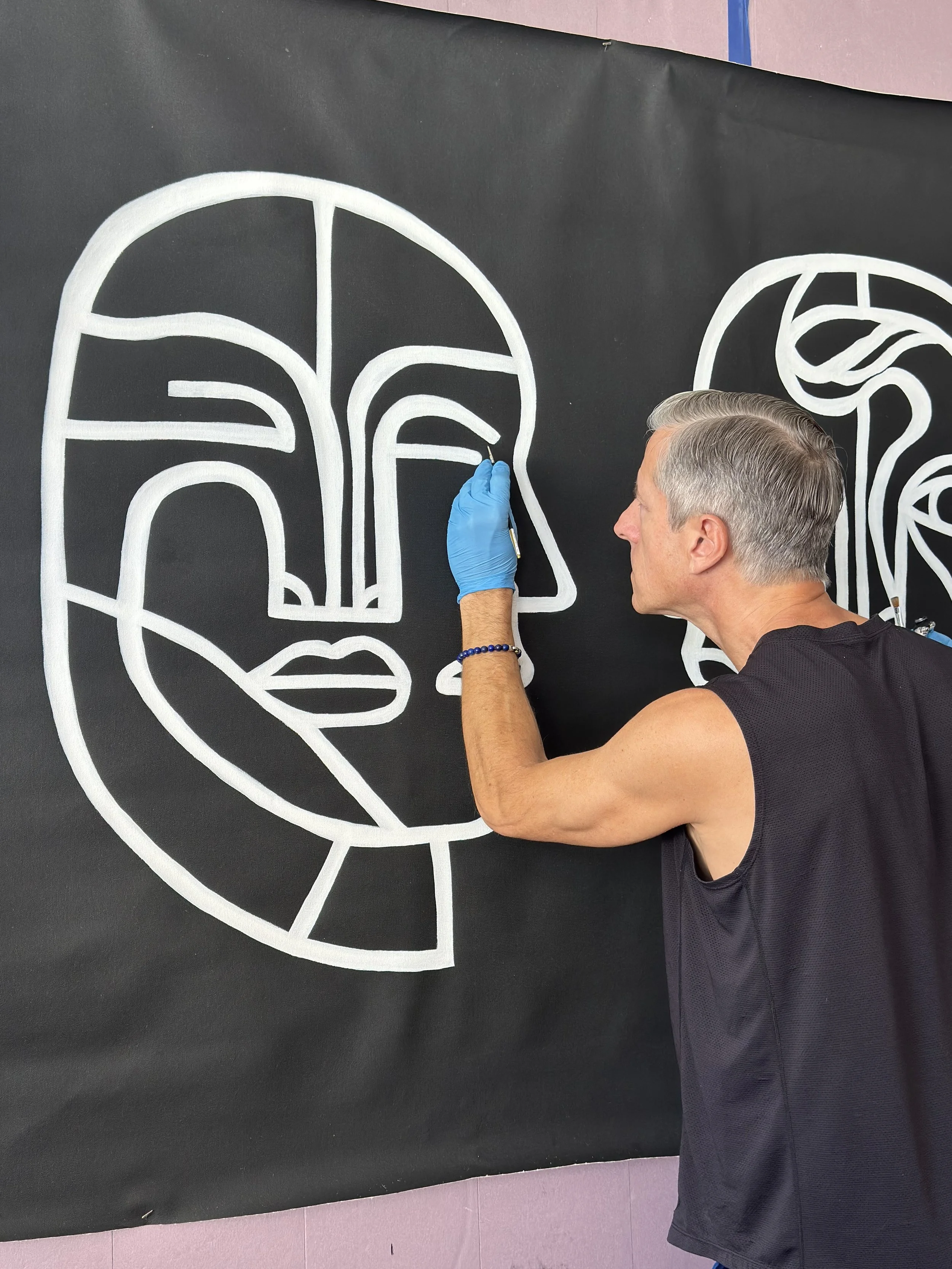
There was no existing blueprint for executing clean, definitive lines at this scale. I had to invent the technical mechanics. And when I’m in front of the canvas, the first mark is a kind of threshold crossing. Then the process becomes cathartic in a completely different way than my older practice was. The line is built through deliberate, steady repetition. What looks effortless in the finished work involves a lot of physical and psychological investment. Completing each of these pieces feels like running a marathon.
I’ve destroyed many canvases after weeks of work because a correction that seemed minor became structural, and in this minimalist framework, you can’t paint over a mistake without destroying the purity of the entire line. The finished piece is the one where the line has the confidence it needs. No more, no less.
JS: What roles do accidents and improvisation play in your paintings?
TS: That question highlights the exact pivot point of my artistic reinvention. In my earlier work, happy accidents were cherished treasures. In fact, many of them were genuine instructions that helped teach me how to paint. Body Count is a completely different animal. Initially, my relationship with “perfection” became a real psychological challenge. I was not accustomed to a single unsteady line ruining weeks of labor, or to touch-ups that looked and felt wrong because the surrounding work was so clean. In this minimalist framework, a mistake cannot be casually painted over without compromising the integrity of the line.
Through the current series. my relationship with “perfection” has changed. What I’m discovering is that the rigor is its own form of freedom. The constraint clarifies everything. And while the large figures demand a different contract with the canvas, it’s my line, take it or leave it!! I look forward to evolving this work, and I see the negative space becoming a catalyst for something I haven’t made yet. I am excited by the ideas of what will come next, but right now I need to build the foundation.
JS: What concerns you most about the current contemporary art world?
TS: What concerns me most is how long the contemporary art world has operated as a closed system - keeping talented voices outside, letting very few in, and telling itself that’s how it’s supposed to work. It has relied on the myth that an artist must belong to a specific, elite club to possess validity. Underrepresented communities, artists without institutional connections, people who developed their practice outside the expected channels - they’ve been systematically excluded.
But that is changing, and I think we’re approaching an inflection point. Technology is disaggregating the gatekeeping infrastructure. Artists can cultivate audiences directly. The power is shifting. The blue-chip market will always sustain itself. For a certain tier of collector, brilliant masterpieces will unfortunately remain financial instruments - bought, sold, and stored in tax havens rather than actually being lived with or appreciated as art should be. But technology is permanently decentralizing that authority. Over the next decade, I
see institutional relevance of art fairs and commercial galleries facing a real reckoning. Adapting is no longer just a competitive advantage. It’s a survival necessity.
JS: Has the increasing influence of the art market affected artistic freedom?
TS: Absolutely - and in both directions. On one hand, market influence has created real pressure on artists to produce what commercial decision- makers have decided taste looks like, rather than following the logic of their own practice. When a select group of tastemakers defines artistic value primarily through ROI and auction metrics, emerging artists face enormous pressure to replicate their initial successes rather than taking the dangerous, necessary risks required to find their authentic voices. In my opinion, that closes doors and can stifle an artist’s creative voice.
But I do see a silver lining. Digital ecosystems and direct-to-collector transparency are empowering artists to bypass the traditional gatekeepers entirely. An artist can now build a real audience - collectors, institutions, advocates - without waiting for permission. That’s a form of freedom that simply didn’t exist twenty years ago, and it changes the power dynamic in ways the market is still catching up to. There will always be a critical place
for galleries, fairs, and art markets. However, the artists who will define this next era will be the ones who leverge that freedom to develop a truly distinct voice - not to mimic what the market currently rewards. Authenticity is the long game.
JS: What role should museums and galleries play in supporting artists whose work resists easy categorization?
TS: Museums and galleries have a responsibility to the public that goes beyond consolidating existing taste. That means actively supporting work that doesn’t fit neatly into established categories, because the most interesting art rarely does. The cost of conventional thinking isn’t just to the artists who get overlooked - it’s to the audiences who never encounter work that could change something in them. Galleries and museums need to stop operating as conservative real estate holding companies and return to being genuine incubators. True curatorial courage requires investing in the unclassifiable. When a work intentionally blurs the lines between fine art, street culture, cinematic narrative, and psychological documentation, it forces the viewer out of passive consumption. That is the highest function of a museum - not to archive taste, but to expand it. And the galleries should always play a large part in this formula. If you ask me, the institutions that will matter in twenty years are the ones making those bets now.
JS: Looking back over your career, what have been your most important artistic discoveries?
TS: The most important discoveries have come every time I forced myself out of my comfort zone. Transitioning from the dense, controlled chaos of my early paintings to the stark restraint of Body Count was a terrifying leap. It required transforming my entire physical and mental approach to the canvas. But the lesson I keep relearning is this: a willingness to abandon a technique or format I had mastered was always the essential ingredient for becoming the artist I needed to be next. Substantial, sometimes painful changes in format and technique are exactly what true artistic growth requires. Discomfort is often the point. It was always that discomfort that produced the real discoveries.
JS: How has your work evolved beyond your early influences?
TS: The evolution has been profound - and it’s ongoing. My current work looks almost nothing like where I started. But the influences haven’t disappeared; they’ve been absorbed. Haring’s democracy of the line, Dubuffet’s refusal of convention, Longo’s psychological charge, Weegee’s reduced honesty, these are part of my visual DNA now. They inform every decision without announcing themselves. And all the other artists who influenced me, I salute them.
I treat art history as an active, ongoing interrogation rather than a passive archive. What I’ve moved toward is a practice that uses those foundations to say something new - about this moment, these bodies, this fractured and connected world. I’m not interested in being a footnote to the artists who shaped me. I want to be part of the next sentence. The lineage matters, and the departure from it matters equally.
JS: What questions continue to drive your practice today?
TS: The human condition and the Hero’s journey has always been at the center. What drives me now is the form that condition takes in this particular moment - this remarkable point in history - a world that is simultaneously more connected and more divided, where identity is both more fluid and more contested. Today, the body itself has become political terrain.
I keep asking: can a single outline hold all of that? Can the simplest possible representation of a person - just their edge, just their contour - carry the weight of who we are and what we’re going through?
And the larger question that runs underneath all of it: who are we to each other? What connects us across the things that are supposed to divide us? I do not paint to dictate an ideology.
I build visual arenas. I want to initiate a dialogue that the audience must ctively participate in and complete on their own terms. The questions remain ancient and urgent: who are we, where are we going, and how do we forge a genuine connection in an era designed to keep us violently divided?
JS: What advice would you offer emerging artists seeking to build authentic careers?
TS: Stay open - that’s the whole thing. Stay open to changing, to being wrong about yourself, to finding out that what you thought was your voice was just the beginning of it. Authenticity isn’t a destination you arrive at, it’s a practice you commit to every day.
If you paint for the current trend, your career will die with the trend. Treat external opinions, institutional critiques, and the fickle rhythms of the art market with a gargantuan grain of salt. Take criticism seriously without letting it define you. Be true to the work, do the work, and refuse to ask for permission. The audience finds the authentic voice - it always has and it always will. Just give it something real to find.
JS: How would you like future historians to position your work within the history of contemporary American art?
TS: I hope they see it as a natural next step work that took the path laid down by Haring, Dubuffet, Longo, Weegee, and others who believed deeply in the power of the figure and the line, and extended it somewhere genuinely new. If Body Count and my prior series hold up as a body of work that captured something true about this particular moment in history - about who we were, what we were afraid of, what we still hoped for - that’s more than enough. The ambition isn’t fame. It’s relevance. The kind that keeps a conversation alive long after I’m gone.
JS: What do you hope audiences experience emotionally after encountering your work?
TS: I respect my audience too much to deliver comfortable, decorative art. I want them to feel something they can’t quite name at first - that slight disorientation when a simple image opens up into something larger than it first appeared. That’s the experience I’m after. My old work expresses a certain energy and the early figurative work’s connection to where I am now. There is power in all of that which I hope affects the audience in a visceral way.
Body Count, especially when the works are seen together, is designed to accumulate. Each figure contributes to a collective weight. Everyone brings their own history to what they see, and I want my work to meet that history - to find the place where their experience and my intention intersect and create something that belongs to neither of us alone.
If they leave still thinking about it, still carrying one of those outlines in their mind, still somewhere inside that dialogue - then the work has done exactly what it set out to do. That’s the connection that matters most.