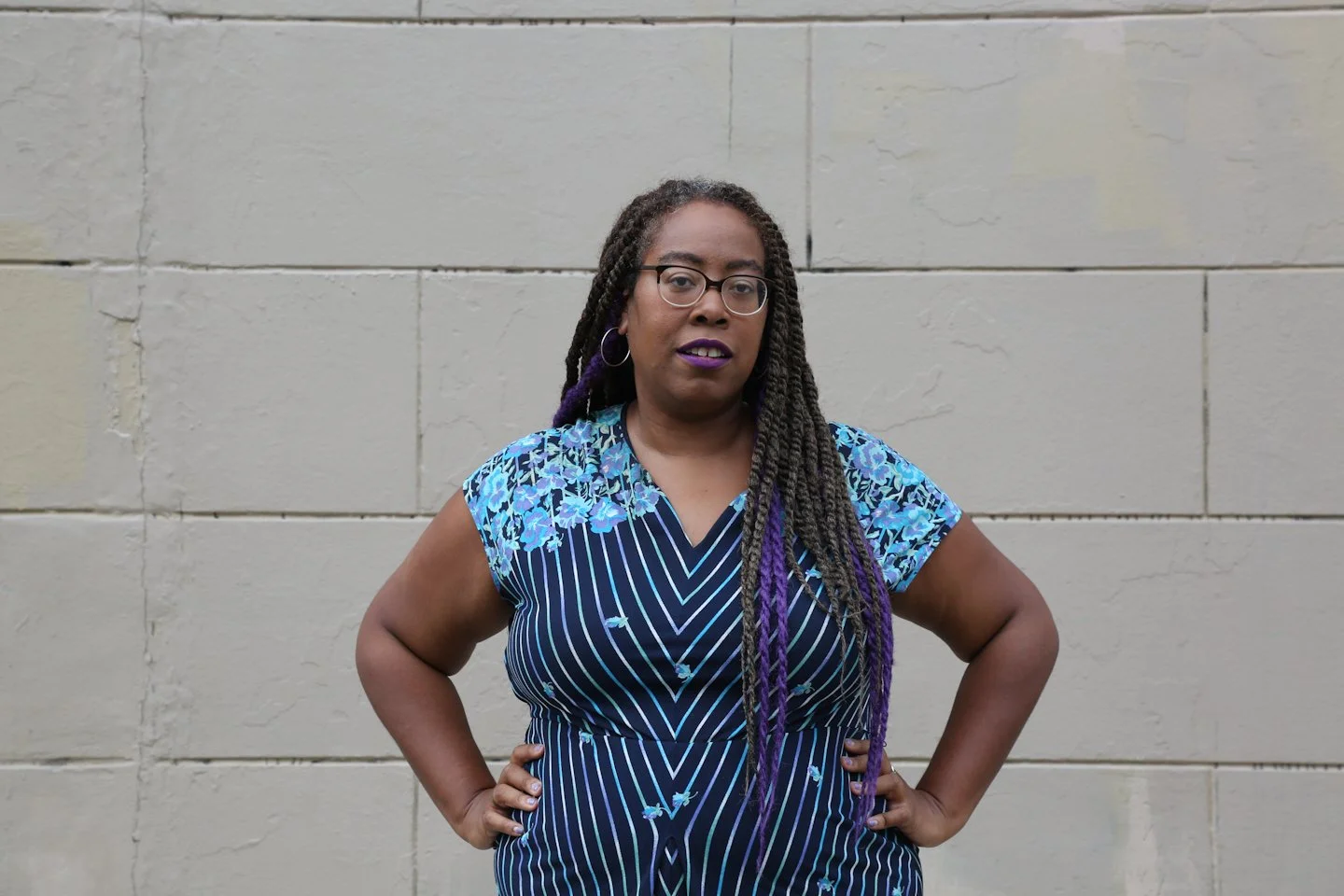
INSIDE OUT: ANGELA LYNN TUCKER A TIME WHEN THIS COULD HAPPEN
“Black people know what time it is.”
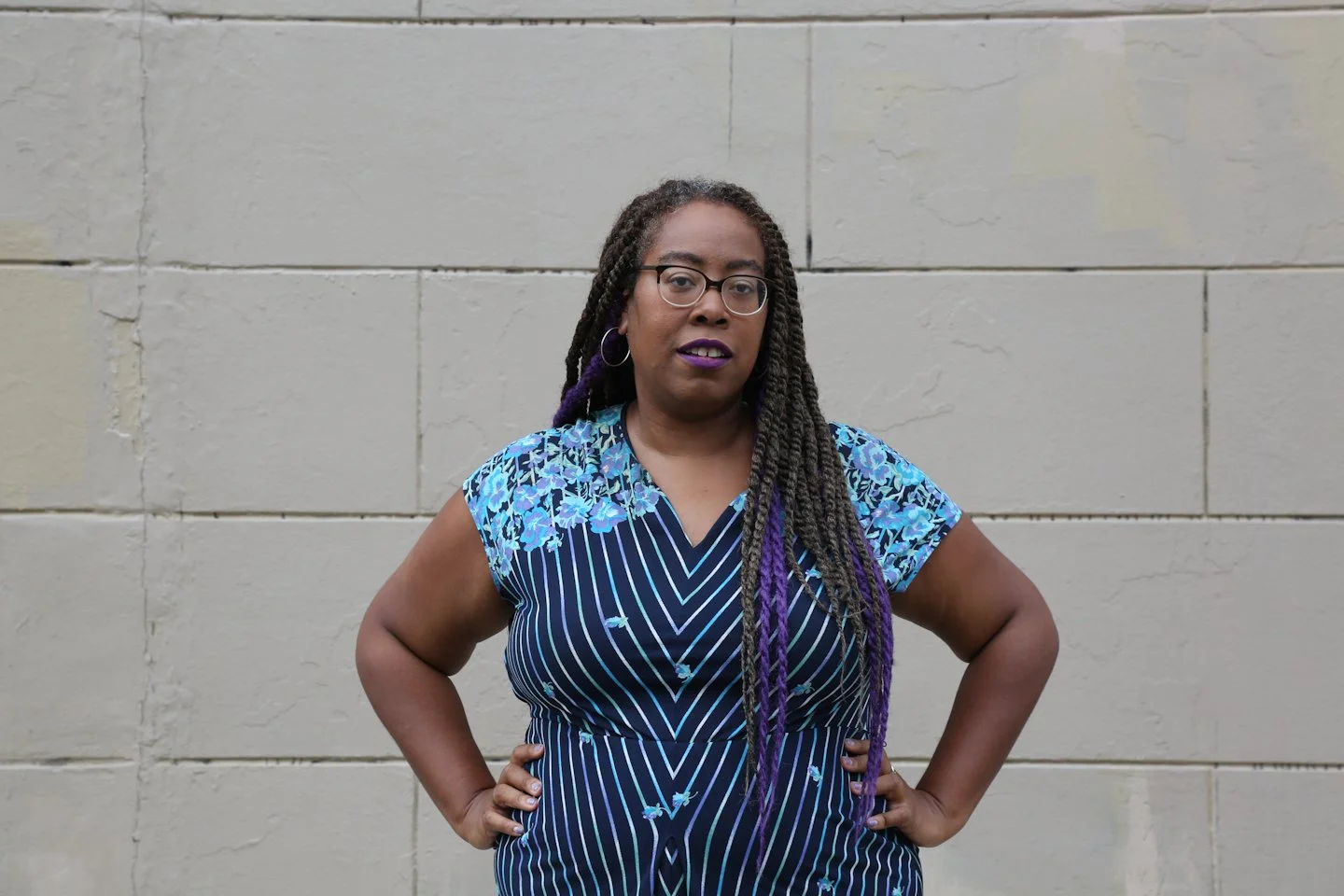
Angela Lynn Tucker is a filmmaker, visual artist, curator, and professor. Widely known for her documentary feature films (All Skinfolk Ain’t Kinfolk, (A)sexual, and Belly of the Beast) and web series Black Folk Don’t, she is a recipient of an Emmy Award and member of the Academy of Motion Picture Arts and Sciences. Her most recent film, The Inquisitor, explores the life of the inimitable Barbara Jordan, who hailed from Houston, Texas and was the first Black woman to serve as a United States Senator. Yet the film is also a portrait of the United States and of its promises playing out--and not playing out--in real time, drawing into relief the United States of fifty years ago in the 1970s, to where we are as a nation today, and revealing resonances between two visionaries from these times periods, Barbara Jordan and Angela Tucker.
While studying Jordan’s life, Tucker developed a vibrant studio art practice and body of work that influenced her directorial vision and comprised the exhibition More is Required. Her curatorial debut, Time is a Shapeshifter, features the work of twelve women of color from across Louisiana. We spoke in person at The Front gallery, only two days before Tucker and her husband and DP, Duane Prefume, moved from New Orleans to Houston.
Rebecca Snedeker: What is your main drive as an artist and what practices are you using to pursue that calling?
Angela Lynn Tucker: I’m on a personal drive to tell stories from the interior lives of Black women, like myself. In this moment, when so many Black voices are being sidelined, this feels more important than ever. I feel really good about my film career, and this opened me up to be able to try other things, and I’ve always been interested in the art space. It’s been exciting, at the age I’m at, to feel like I can teach myself something new. I’m still learning how to do collage. I’m still learning what kind of glues to buy, how to finish a work. It’s hard to be a creative anything right now. You might as well follow whatever you want to do.
RS: It was incredible to finally watch The Inquisitor. The film shapes a narrative of the life of Barbara Jordan, the first Black woman to serve in the US Senate, who had, as she called it, a “clarion voice.”
ALT: She was somebody who had a belief in herself. I learned so much from making that film, and that’s something I took away--a complete belief in myself. In a culmination of sorts, I feel clear and strong about what my voice is and what I bring to the table and the kind of stories I want to tell. I know a lot about Barbara Jordan. I know a lot about what I want to say in this moment. And the cyclical nature of history became the theme of the film: you can see that we’ve been in this moment before, and we will be there again until real change has happened.
RS: One temporal echo in the film is the reckoning with presidential power and accountability. You conveyed Jordan’s crucial role in the Watergate hearings, and placed Watergate in a wider cultural context.
ALT: Every time I watch the section on Watergate, it’s rough. Watergate feels quaint now. Nixon doesn’t seem that bad. That’s how bad it is now. Because at least Nixon resigned. He knew, things have gotten to a point that I need to resign. But Trump is totally different.
RS: When and how did you know you wanted to make this film?
ALT: Through All Skin Folk Ain’t Kin Folk, which follows the 2017 mayoral election in New Orleans between
two Black women candidates, and other work, I’ve explored the legacy of Black women politicians, and, ultimately, moved into how Black women’s needs aren’t really discussed in these processes, even though
we’re supposed to save the day for everybody. My archivist showed me the clip of Barbara in the Watergate hearings, then I went to find the documentary about her that I was sure existed. Did not exist. With the pandemic, I started watching archival footage of her--C-SPAN and Bork hearings. It became clear there has to be a film.
So, it evolved over time. Different things I saw were things I wanted people to know about. The clip
from after her death, where all these Republican, southern, white men talk about how much they miss her. That felt like something I had never seen before. I thought, that’s something that people need to know. There was a time when this could happen.
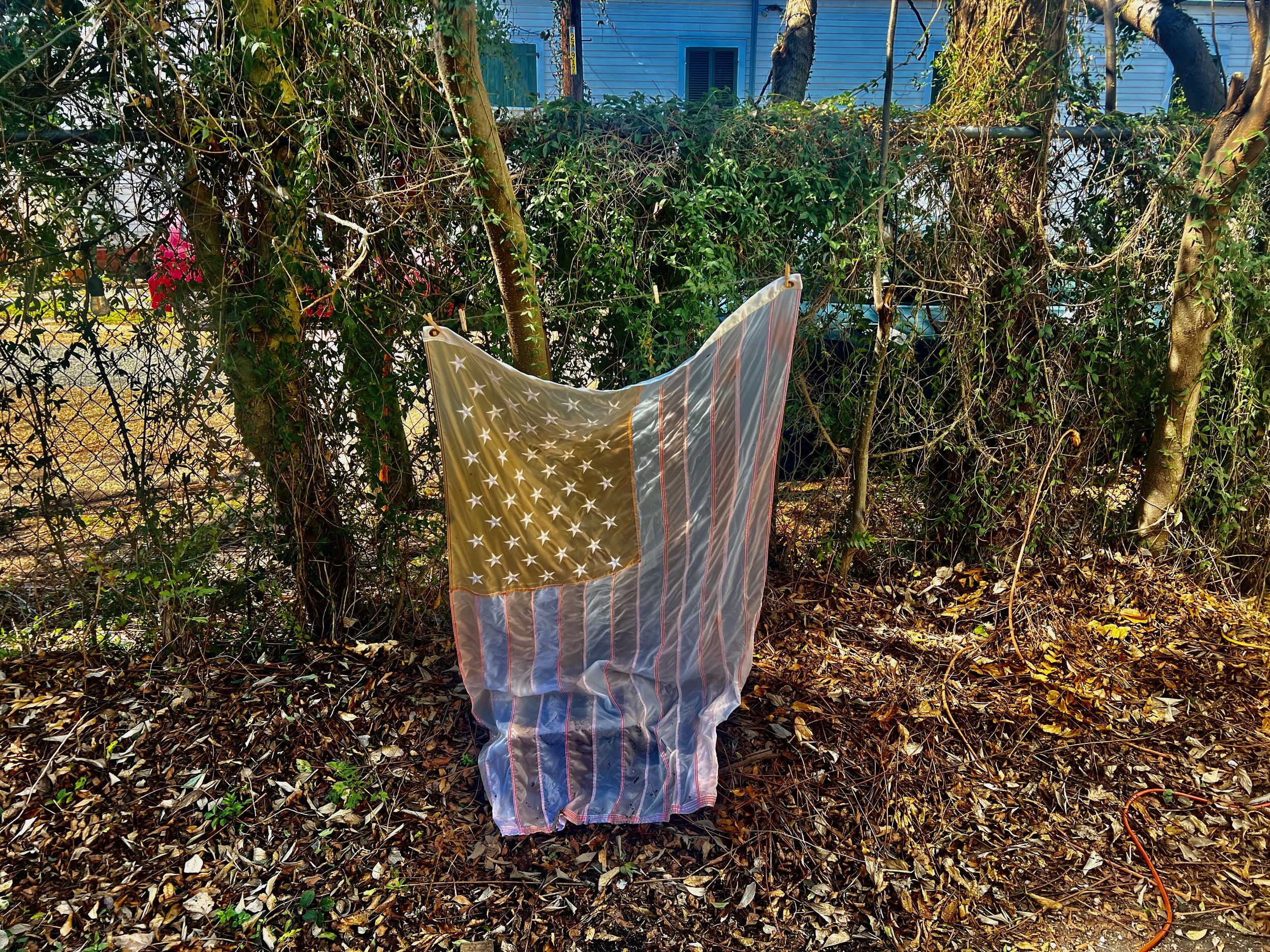
RS: Barbara gave an electrifying speech at the Democratic National Convention in 1976, and, in it, she talks about how “more is required” of us, as a culture. You chose this phrase as the title of the exhibit that compliments the film. The image of your sculpture of the US flag, curled up in a jar of bleach, lodged in me.
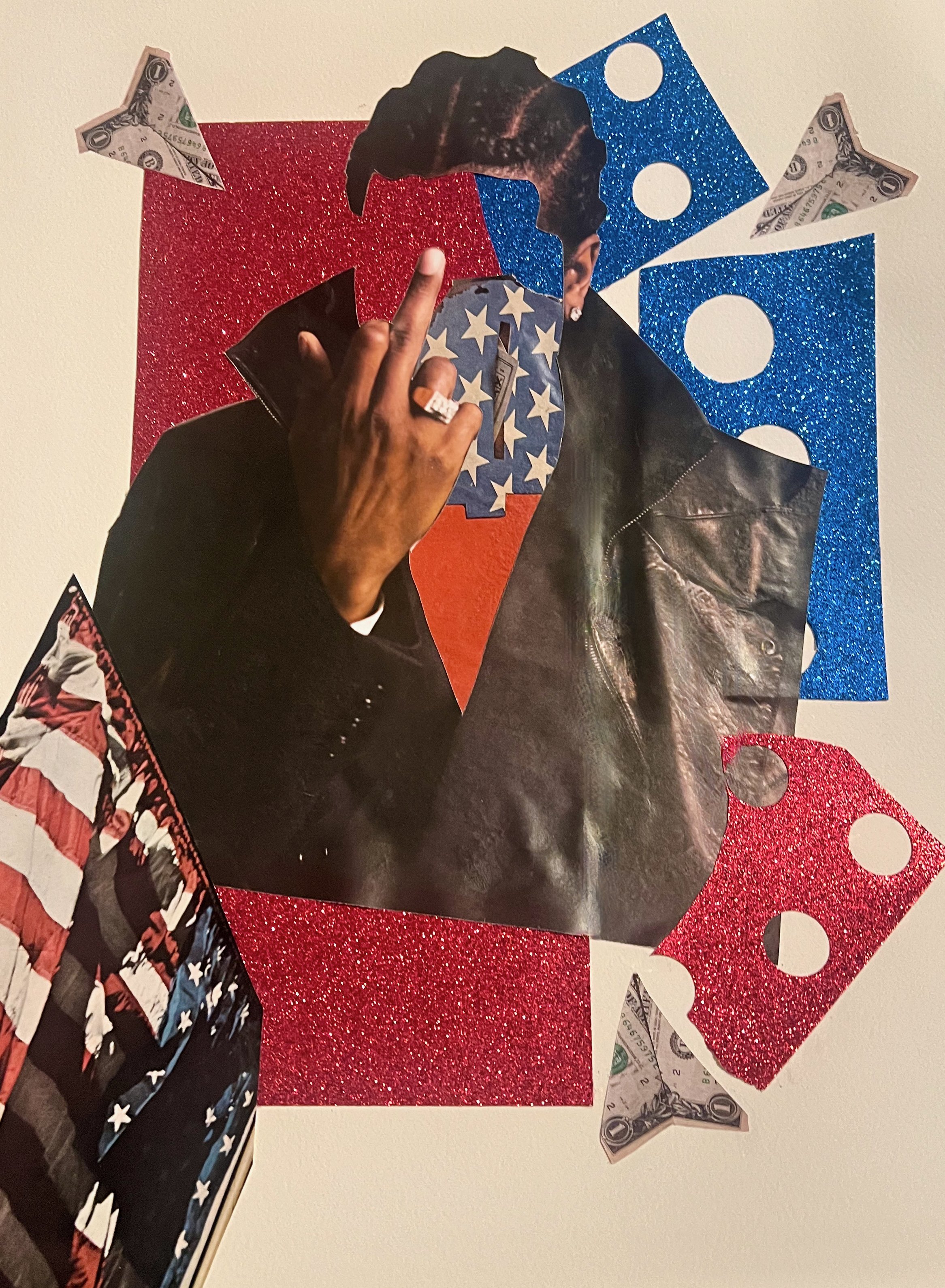
ALT: I had the collages and the paintings, which I had used to come up with the visual language of the
film, and I wanted to do something with the flag. I was interested in these symbols that we have--the iconography of justice and democracy--and the question of what do they mean now? And I’d become interested in time- based pieces. So, I thought, what is it like if you just have something sit around, and how does it change, over time? What would it be like to put a flag in bleach for the whole run of the of the show? One day, Duane saw the packing foam resting on top of the huge, glass jar I’d ordered and said it looked like the Liberty Bell, so I went with it. And I wanted to use Black women’s hair, reflecting our labor. The beam on top of the bell is made of the foam and the flag is in the jar, floating in half bleach, half water. Then I put two books next to it, the US Constitution and Frantz Fanon’s The Wretched of the Earth. Something that I had to think about a lot in making The Inquisitor was that Barbara Jordan, the legislator, was operating at the same time as Stokely Carmichael and Angela Davis. And you can hear in Barbara’s talking--the feeling that she can’t be militant in that Black Power way. What must this have been like? You’re not the cool Black person...
RS: You’re wearing your pantsuit to the Hill...
ALT: Yeah, exactly. ...even though you are doing incredibly hard, important work. I know, as a Black person,
how hard it is when people act like you’re not being militant enough in a situation. That’s why I kept the line in the film when she says, “I’m militant in my insides.” Now I want to do a photo series with the bleached flag. It’s kind of amazing, what it turned into. You can see the beauty of it.
RS: In Time is a Shapeshifter, you invited twelve women of color, from across Louisiana and at least forty years old, to exhibit work. And this is the first show for about half of them.
ALT: So many older artists have so many stories to tell. And for some people, the chance to exhibit changes their lives. I know that personally and wanted to give that experience to other women of color. I had just read Octavia Butler’s biography. I’m always thinking about her in terms of Blackness and time, how she predicted the future and how so many other Black women have as well. And it’s because we have lived through the worst of it. I think there’s a naivete about how bad it can get, and we know how bad it can get. I told the artists: this is the opportunity to say what you want to say. And I included the barge board sculpture, because I imagine that piece as a timeline that exists both vertically and horizontally. I see it being hung either way.
RS: Your piece “We Know What Time It Is (1884)” references the year when time was standardized in the US, the same year as the World’s Industrial and Cotton Centennial Exposition here.
ALT: I got that clock at a swap. I gave paint, and someone had an old clock I was drawn to. I wondered, what am I doing with this? And then I really thought about: what is time? It made me research, how did time come to be. So, it used to be, everyone was doing their own thing, and then the UK decided, this is what time is. I was like, wait, time was colonized? I had no idea. That made me see time completely differently. It explains so much. It explains our relationship with time and who created time and why certain cultures deal with time completely differently. It’s not, oh, you have your act together, but all these other countries just do what they want to do and are lazy. Time has different significances in different spaces. When I created that piece, I was reflecting that Black people know what time it is. And this idea that Black people are lazy is... I can’t even. I don’t understand how Black people can build this country but be lazy. Those two things don’t compute. So that’s what that piece represents to me.
RS: Living in the domestic capital of slavery and the petrochemical industry, how are you experiencing the long entanglement of white supremacy and earth extraction, as inherently interconnected causes of climate change?
ALT: I have been thinking a lot about climate change, particularly on the verge of leaving here. And I have become really interested in the notion of ecocide, and why ecocide is not seen as a crime in the US. Other countries acknowledge it’s a crime when humans do all these things that affect the environment in negative ways. But here, we don’t call it that. The US is very against trying to call things like that a crime.
RS: You are also a professor, and you’re moving on to University of Houston. Congratulations.
ALT: Thank you. Yeah. Barbara made that happen.
RS: Oh, right. Beautiful!
ALT: Barbara was like, Girl, you need to come to my home.
RS: I’m picturing the full-cap epitaph on her gravestone, “TEACHER,” shown towards the end of the film. Tell me about the role of teaching in your life. How do you support uncensored expression in today’s political climate?
ALT: It’s such a hard time in education, we’re not able to teach in the ways that we want to. There are certain things that you can’t get into, like critical race theory, and that’s hard. I try to find ways around that, but it’s wild that we’re back to that. I love teaching for a lot of reasons. In some ways, it’s selfish. Teaching reminds me why I like to be creative. Seeing the students’ excitement when something is challenging them, and they figure it out. I really push my students to think about theme, because it helps them understand what they are trying to say, and then to draw out what steps are they taking, to make sure that they’re saying it.
My obsession now is taking the weird thing that happens where filmmakers are one thing, video art makers are another, and never the two shall meet. That is what I’m demystifying in my work, because I think you just need to make work and then figure out the best space for it.
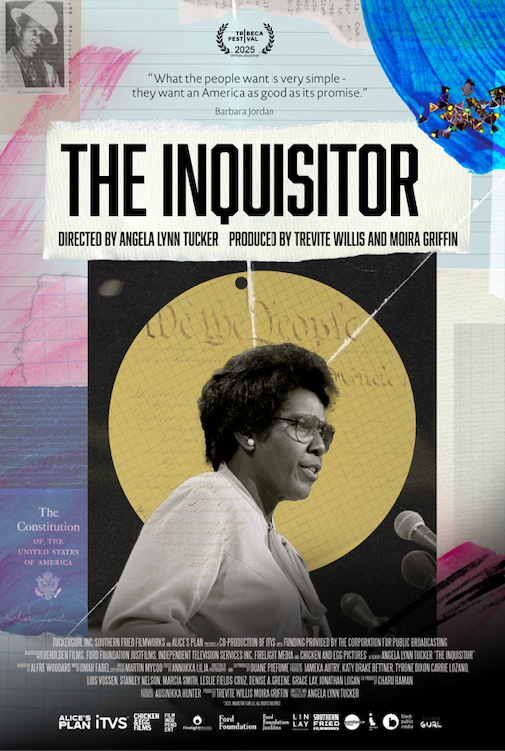
With The Inquisitor, I have a two- minute experimental video that was in “More is Required.” There are some people who are only going to see that piece, and there are some people who are only going to see
the movie. There are some people who might see a collage. So, all these things speak to each other. And that’s what I think is the future, making
all these different things that can communicate and travel in different spaces. It gives the work a longevity. If I just had the movie The Inquisitor, that’s fine. But I have always felt like I have more to say and the themes that Barbara was talking about need to be discussed in a lot of different ways.
Recently, at Kolaj Fest, I screened the film and then led a collage workshop. I shared the theme and prompt, “what more is required?” and then had people journal and make collages, from that headspace. I want to do more of these workshops and put all the collages into a book. That is the dream.
RS: Social practice art, too. Yes. Having the investigation have this ample material life leverages all that you studied and learned, your response to the whole--and now others’ responses as well.
ALT: I spent five years reading and thinking and having conversations, and there is so much I learned and felt Barbara’s words could benefit people right now.
RS: Is there anything else you want to share today?
ALT: The big thing is being open to work in different formats to tell your story and not being afraid if one format is something that you’re not as experienced in. You don’t have to be afraid to touch upon a new genre, to enhance what you’re trying to say. Many great artists worked in all kinds of different formats, and that’s something that I’ve been opening myself up to. The documentary, the video, the collage, the sculpture, these workshops. All of it. They are all speaking to this theme “more is required,” and this notion of history. There are a lot of Black artists, in particular, who are working this way, because we have to create our own space to get the work out there and to tell the stories we want to tell. It’s been very satisfying.
RS: You are a powerful artist, and it’s a joy and inspiration to see you evolve. Thank you for this time together.