ARTVOICES ART & BOOK FAIR REIMAGINING THE CONTEMPORARY ART FAIR
“The absence of a 2027 edition of Prospect New Orleans presents a rare opportunity to imagine a different future. Since 2018, I have envisioned the ARTVOICES Art & Book Fair as an alternative model one that places curatorial excellence, scholarship, independent art book publishing, and meaningful relationships between artists, galleries, collectors, and the public at its center. ARTVOICES begins from a different premise: an art fair should succeed only when its exhibitors succeed. Our responsibility is not simply to rent exhibition space but to create an environment where galleries have the greatest opportunity to build relationships, place important works, and generate meaningful sales “
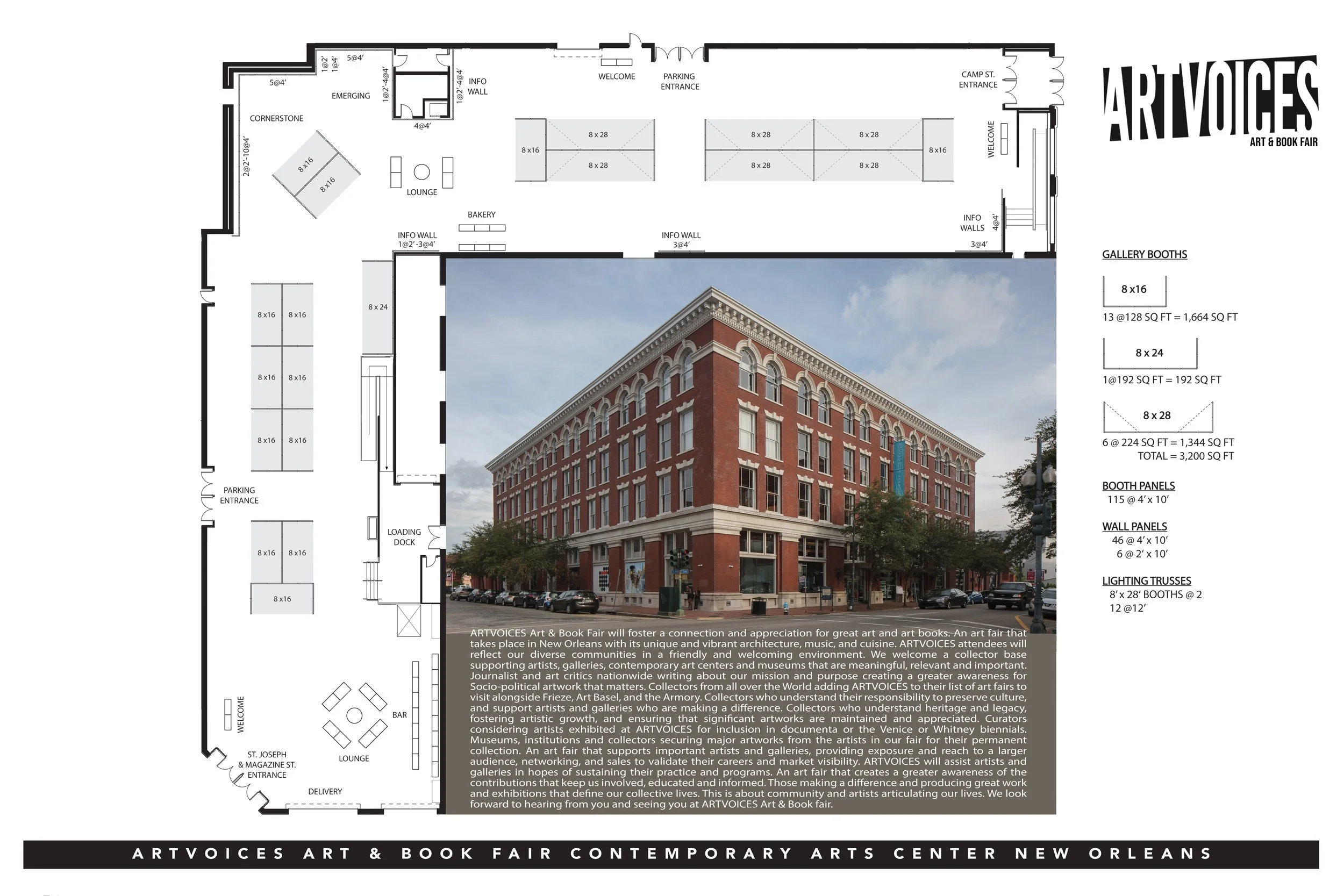
At a moment when the cultural landscape is increasingly shaped by commercial spectacle and algorithmic visibility, the inaugural Artvoices Art & Book Fair proposes a different model, one grounded in dialogue, scholarship, and the enduring relationship between art professionals and enthusiasts. The Art and Book fair will be hosted at the Contemporary Arts Center (CAC) in New Orleans in April 2028, the fair will bring together contemporary artists, independent publishers, university presses, galleries, literary organizations, museums, and cultural institutions in a multidisciplinary forum that celebrates creative practice as both intellectual inquiry and civic engagement. More than a marketplace, the fair is conceived as a space where ideas circulate alongside artworks and books, reaffirming the essential role of culture in shaping public discourse.
Reflecting the editorial mission of Artvoices Magazine, the Art & Book Fair embraces the belief that contemporary art and literature are inseparable from the social, political, and historical conditions in which they are produced. Through curated exhibitions, artist and author presentations, panel discussions, book launches, and conversations with curators, critics, collectors, and scholars,
the fair seeks to foster meaningful exchanges across disciplines while expanding opportunities for emerging and established voices alike. Positioned within New Orleans’ rich cultural history and international creative community, the Artvoices Art & Book Fair aspires to become a significant annual gathering one that strengthens connections between visual art, publishing, and public life while contributing to the evolving discourse of contemporary culture.
Maya Smith: You have described the current art fair model as being at an inflection point. What structural changes have you observed over the past decades, and why do you believe this is the right moment to introduce the ARTVOICES Art & Book Fair?
Terrence Sanders-Smith: Since the inaugural edition of Art Basel Miami Beach in 2002, the international art fair model has evolved from a relatively curatorially balanced marketplace into a highly consolidated global industry increasingly shaped by multinational event companies, luxury branding, and financial scale. While art fairs have undeniably expanded the global art market and introduced new generations of collectors to contemporary art, they have also transformed the economic realities facing galleries and the ways in which art is encountered, interpreted, and collected. One of the most significant shifts has been the consolidation of ownership. Many of the world’s leading art fairs are now operated by large corporations or investment groups rather than independent cultural organizations. This has contributed to a business environment in which financial performance can take precedence over curatorial experimentation, long-term gallery development, and sustained investment in artists. As participation costs continue to rise, many independent galleries face increasing pressure to justify the substantial expense of exhibiting, while collectors (from the novice to the established and educated) often navigate fairs that prioritize trend, gimmick or scale over thoughtful engagement. The result is a growing conversation throughout the art world about whether the current model remains sustainable for the very galleries and artists upon whom its success ultimately depends.
As Mahatma Gandhi famously observed, “You must be the change you wish to see in the world.” ARTVOICES puts that principle into practice, not by rejecting the art fair model, but by reimagining it as a more equitable, intellectually ambitious, and culturally sustainable platform for the Future.
MS: Many commercial art fairs have become increasingly consolidated under large international corporations, while galleries face rising participation costs and narrowing profit margins. How does the ARTVOICES model seek to redefine the relationship between organizers, galleries, artists, collectors, and publishers?
TSS: As a gallerist, art dealer, collector, publisher (both books and magazines), artist, and curator, I have experienced every facet of the contemporary art ecosystem. I understand firsthand the optimism that accompanies preparing for an art fair, as well as the uncertainty, financial risk, and disappointment that too often follow. Since 2020, those challenges have only intensified. I know what it feels like to arrive on Sunday evening having invested tens of thousands of dollars in booth fees, shipping, installation, travel, and staffing, only to realize that while the fair itself has been financially successful, manyof the participating galleries have not. Beyond the cost of admission, exhibitors are frequently charged additional fees for lighting, furniture, electricity, marketing opportunities, drayage, and countless ancillary services. The financial burden placed upon galleries has become increasingly difficult to justify, particularly for those whose primary mission is supporting artists rather than maximizing short- term profit. Equally concerning is the erosion of curatorial identity within many commercial fairs. Without a clear intellectual framework, an art fair can become less an exhibition than a marketplace where quality, historical context, and artistic rigor compete with spectacle and volume. Visitors are often confronted with a confusing mixture of established galleries, artist-run booths, and works that closely imitate established blue-chip aesthetics. Such environments can blur important distinctions within the contemporary art landscape and make meaningful discovery more difficult for collectors, institutions, and the public.
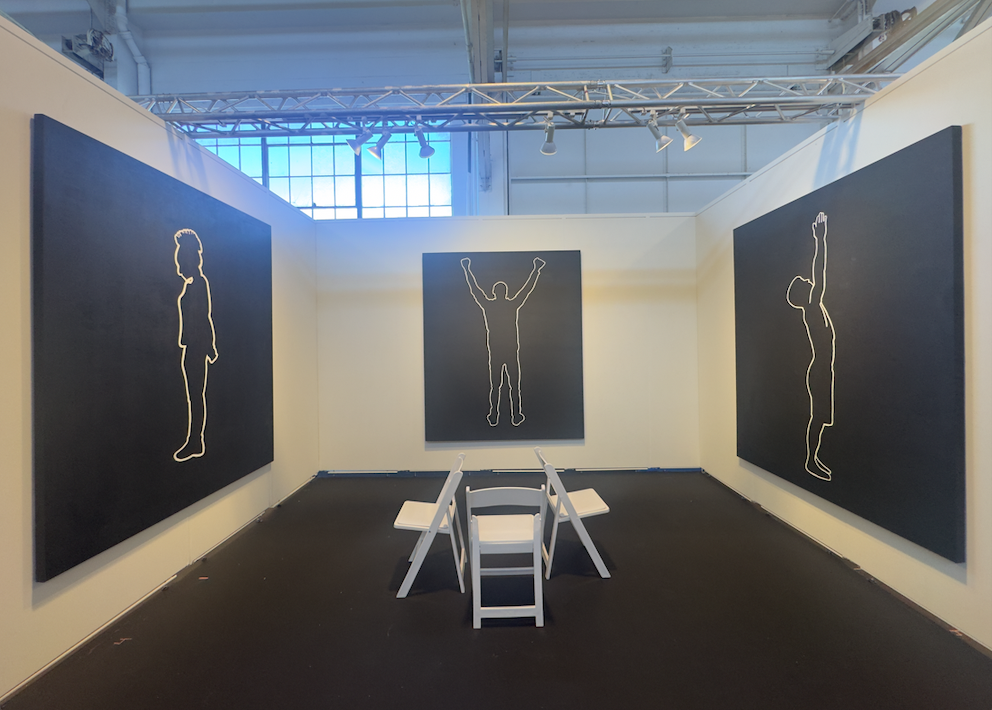
ARTVOICES was conceived as a direct response to these conditions. Our objective is to reduce unnecessary overhead for participating galleries while assembling a carefully selected group of exhibitors whose programs speak to one another through a shared commitment to excellence. The fair will be organized as a series of museum-quality solo presentations, creating an experience that resembles a biennial where every work is available for acquisition. Original works, not reproductions will form the core of each presentation, reinforcing the significance of collecting unique artistic contributions. To preserve the integrity of every exhibition throughout the duration of the fair, sold works will remain on view until closing and will be collected or delivered afterward. In doing so, ARTVOICES places the visitor’s experience, the artist’s work, and the gallery’s program above the transactional urgency that too often defines the contemporary art fair Model.
MS: Rather than presenting hundreds of exhibitors, ARTVOICES proposes a highly curated boutique format. What are the intellectual and commercial advantages of prioritizing quality over scale?
TSS: The prevailing assumption in the art fair industry has been that bigger is better, that success is measured by the number of exhibitors, square footage, and attendance. I would argue the opposite. Intellectual value and commercial success are not necessarily products of scale; they are products of intentionality. By limiting ARTVOICES to approximately eighteen to twenty-two carefully selected galleries and independent art book publishers, we can create a fair where every participant contributes to a coherent cultural conversation. Visitors are not overwhelmed by hundreds of booths competing for attention. Instead, they are invited to slow down, engage deeply with the work, and understand the historical, conceptual, and cultural contexts that give it lasting significance.
Commercially, this model benefits everyone involved. Galleries gain greater visibility because they are no longer lost in a sea of exhibitors, while collectors have the time and space to build meaningful relationships with artists, dealers, and publishers. The emphasis shifts from impulse buying to informed collecting, where acquisitions are made with confidence, scholarship, and long-term value in mind. ARTVOICES is designed to feel less like a convention center and more like a museum exhibition or biennial where the work happens to be available for acquisition. We believe the future of the art fair lies not in presenting more art, but in presenting better conversations around exceptional art. Quality over quantity is not simply a curatorial philosophy it is a sustainable business model that respects artists, supports galleries, and cultivates collectors who view themselves not merely as buyers, but as stewards of our shared cultural heritage.
MS: You have said that ARTVOICES should feel “like a biennial where everything is for sale.” What does that statement mean in practical terms, and how do you balance rigorous curatorial standards with the realities of the art market?
TSS: The most successful biennials are remembered not because of the number of artists they include, but because they present a compelling curatorial thesis. Visitors leave feeling as though they have experienced an exhibition that expanded their understanding of contemporary art and the world around them. That is precisely the experience I want ARTVOICES to offer. Rather than entering a convention hall filled with hundreds of disconnected booths competing for attention, I want collectors, curators, museum directors, and the public to feel they are walking through a thoughtfully organized exhibition where every gallery presentation contributes to a larger cultural conversation. The distinction is that every work is available for acquisition. In that sense, ARTVOICES becomes a biennial where collectors have the rare opportunity not only to experience important work but also to become its steward.
To preserve the integrity of each installation, sold works will remain on view until the fair closes and will be delivered afterward, ensuring that every visitor experiences the exhibition as originally conceived. We will prioritize original works over editions, emphasize historical context alongside emerging voices, and integrate lectures, artist talks, publishing, and educational programming into the fair. Commercial success and curatorial rigor should never be viewed as opposing forces. Collectors increasingly seek knowledge, context, and confidence before making acquisitions.
MS: New Orleans has become internationally recognized through Prospect, yet no edition is planned for 2027 or 2028. In what ways does ARTVOICES build upon that cultural foundation while establishing its own distinct identity?
TSS: Prospect transformed the cultural landscape of New Orleans by demonstrating that the city could sustain an international conversation about contemporary art. Over six editions, it attracted artists, curators, collectors, critics, and visitors from around the world while proving that New Orleans is more than a city of extraordinary music, cuisine, and architecture it is also a destination for serious contemporary art. ARTVOICES owes a debt to that achievement. We are not attempting to replace Prospect; rather, we hope to build upon the audience, infrastructure, and international awareness it helped cultivate. Every successful cultural movement leaves a foundation for the next generation, and ARTVOICES is an opportunity to continue that momentum rather than allow it to dissipate. Equally important is our commitment to New Orleans itself. ARTVOICES is envisioned not simply as a three-day event, but as the catalyst for a citywide New Orleans Art Week that activates museums, galleries, universities, artist- run spaces, bookstores, and cultural organizations across the city. The goal is to generate sustained economic activity for the city while strengthening its identity as one of America’s most dynamic centers for contemporary art. New Orleans has always thrived at the intersection of creativity, history, and community. ARTVOICES seeks to honor that legacy by creating an institution that is intellectually rigorous, commercially sustainable, and culturally indispensable for artists, collectors, and the public alike.
MS: ARTVOICES brings together contemporary art, independent publishing, photography, architecture, criticism, and public programming. Why is it important for an art fair to function as an interdisciplinary cultural forum rather than simply a marketplace?
TSS: Art has never existed in isolation. Throughout history, the most important cultural movements have emerged through dialogue between artists, writers, architects, photographers, musicians, filmmakers, critics, curators, and scholars. The Renaissance, the Bauhaus, the Harlem Renaissance, Black Mountain College, and the downtown New York art scene of the 1970s all flourished because ideas moved freely across disciplines. Contemporary art should be understood within that same tradition. When an art fair functions solely as a marketplace, it risks reducing works of art to commodities. When it functions as a cultural forum, it becomes a place where ideas are exchanged, relationships are formed, and artistic practices are understood within their broader historical, political, and social contexts. MS: Galleries across the United States and Europe continue to downsize, merge, or close altogether. How should art fairs evolve if they are to remain sustainable partners rather than financial burdens for galleries?
TSS: The future of the art fair depends on recognizing a simple truth: without healthy galleries, there is no sustainable art market. Galleries are the primary investors in artists. They discover emerging talent, produce exhibitions, publish catalogues, fund studio production, attend international fairs, cultivate collectors, and often support artists for years before seeing
a financial return. Yet the current art fair model frequently places the greatest financial burden on the very galleries that make the ecosystem possible. Many galleries invest tens of thousands of dollars before the doors even open. If sales fail to materialize, the fair remains profitable while the gallery absorbs the loss. That imbalance is neither sustainable nor healthy for the future of contemporary art.
ARTVOICES is not attempting to build the largest art fair but seeks to build one of the most respected. By restoring curatorial integrity, reducing unnecessary financial burdens, and fostering meaningful relationships among artists, galleries, collectors, museums, and publishers, I believe we can demonstrate that commercial success and cultural responsibility are not competing objectives. They are, in fact, inseparable.
MS: Today’s collectors, particularly younger generations, often collect differently than previous generations. How do you believe collector behavior is changing, and how has that influenced your vision for ARTVOICES?
TSS: Collector behavior is becoming more informed, more values driven, and less dependent upon the traditional hierarchies of the art market. Previous generations were often introduced
to collecting through established galleries, museum boards, auction houses, or trusted advisers. Those structures remain important, but younger collectors are also discovering artists through social media, independent publications, artist-run spaces, podcasts, studio visits, and direct engagement with cultural communities. They are more willing to question inherited definitions of importance and to look beyond a familiar group of blue-chip names.
Many younger collectors are not simply asking, “Will this work increase in value?” They are also asking, “Who made it? What does it represent? What community does this artist come from? What ideas am I supporting through this acquisition?” They want transparency, context, authenticity, and a personal relationship with the work. They are often interested in artists who reflect their own experiences or expand their understanding of race, gender, identity, politics, technology, and the environment. For them, collecting can be an expression of cultural participation as much as financial investment.
At the same time, many emerging collectors feel alienated by the conventional art fair. The scale can be overwhelming, prices are frequently hidden, and the atmosphere can suggest that meaningful collecting is reserved for insiders or the extremely wealthy. ARTVOICES is designed to dismantle some of those barriers. Through focused solo exhibitions, clear scholarship, artist conversations, independent publishing, criticism, and educational programming, we want to give collectors the knowledge and confidence necessary to make thoughtful decisions. The goal is not to pressure someone into buying quickly, but to help them understand why an artist and a body of work matter.
MS: You have spent your career working as an artist, curator, gallerist, art dealer, magazine editor, and publisher. How has working across these different sectors shaped your philosophy for building an art fair that serves the entire cultural ecosystem?
TSS: I have always believed that the art world functions as an ecosystem, not a collection of isolated professions. Too often, we divide ourselves into categories: artist, curator, dealer, collector, publisher, critic, museum professional as though our interests are separate. In reality, each depends upon the other. An artist needs a gallery willing to take risks. A gallery depends on informed collectors. Collectors rely on critics, scholars, curators, and publishers to provide historical context. Museums preserve cultural memory, while magazines and books document the conversations that define an era. If any one of those components becomes weak, the entire system is affected.
We are intentionally bringing together galleries, artists, collectors, independent publishers, museums, architects, photographers, critics, and scholars because each contributes something indispensable to contemporary culture. A collector may purchase a work from a gallery, attend a panel discussion with the artist, discover a monograph from an independent publisher, meet a museum curator, and leave with a deeper understanding of the work’s historical significance. Those experiences reinforce one another. They create lasting relationships instead of one-time transactions.
TSS: I have always believed that the art world functions as an ecosystem, not a collection of isolated professions. Too often, we divide ourselves into categories as though our interests are separate. In reality, each player depends upon the other. An artist needs a gallery willing to take risks. A gallery depends on informed collectors. Collectors rely on critics, scholars, curators, and publishers to provide historical context. Museums preserve cultural memory, while magazines and books document the conversations that define an era. If any one of those components becomes weak, the entire system is affected.
We are intentionally bringing together galleries, artists, collectors, independent publishers, museums, architects, photographers, critics, and scholars because each contributes something indispensable to contemporary culture. A collector may purchase a work from a gallery, attend a panel discussion with the artist, discover a monograph from an independent publisher, meet a museum curator, and leave with a deeper understanding of the work’s historical significance. Those experiences reinforce one another. They create lasting relationships instead of one-time transactions.
MS: One of your long-term ambitions is to establish New Orleans Art Week as a citywide cultural destination. How do you envision museums, universities, independent galleries, artist-run spaces, publishers, and local businesses collaborating to transform the city into an international center for contemporary art?
TSS: ARTVOICES is intended to serve as the catalyst for something much larger, a citywide cultural initiative that celebrates New Orleans as one of the world’s great creative capitals. We already possess extraordinary cultural assets: internationally respected museums, remarkable architecture, world-renowned music, exceptional cuisine, historic neighborhoods, leading universities, independent galleries, artist-run spaces, and a creative community unlike any other. The opportunity is not to invent something new, but to connect these existing strengths into a unified cultural experience that attracts visitors from around the world.
I want art enthusiasts and professionals to think about New Orleans the way they think about Venice during the Biennale or Miami during Art Basel not because we have replicated those events, but because we have created something uniquely our own. New Orleans possesses a cultural identity that cannot be duplicated anywhere else. ARTVOICES and New Orleans Art Week seek to harness that authenticity by bringing together contemporary art, scholarship, publishing, education, music, architecture, and community into a single annual celebration of creativity. If we succeed, the legacy will not simply be a successful art fair. It will be the establishment of New Orleans as one of the defining international centers for contemporary art, cultural dialogue, and creative innovation.
MS: Looking ahead ten years, what would define success for the ARTVOICES Art & Book Fair? Beyond attendance and sales, what lasting impact do you hope the fair will have on artists, galleries, collectors, scholarship, and the future of contemporary art?
TSS: Ten years from now, I hope no one measures the success of ARTVOICES simply by attendance figures or sales volume. Those metrics matter because galleries and artists deserve to be financially successful, but they are only part of a much larger story. The true measure of success will be whether ARTVOICES has helped strengthen the cultural infrastructure that sustains contemporary art, for galleries, artists, collectors, museums, critics and so on.
ARTVOICES will become recognized as a place where scholarship and the marketplace exist in productive dialogue. Art history has never been written by sales alone. It is written through criticism, exhibitions, books, archives, photography, curatorial research, and sustained public engagement. As a publisher, I believe documentation is as important as exhibition. Every fair should contribute something to the historical record.
ARTVOICES will leave behind an intellectual legacy that future scholars, curators, and collectors can study long after the booths have been dismantled. I hope ARTVOICES helps broaden participation in the cultural conversation. I want to see more first-time collectors, more young people, more families, more students, more independent publishers, more underrepresented artists, and more international dialogue. Contemporary art should not feel exclusive or inaccessible. It should invite curiosity, critical thinking, and discovery. The greatest cultural institutions are not remembered because they generated the highest revenues; they are remembered because they changed the way people think about art and broadened a full audience of who participates in its history.